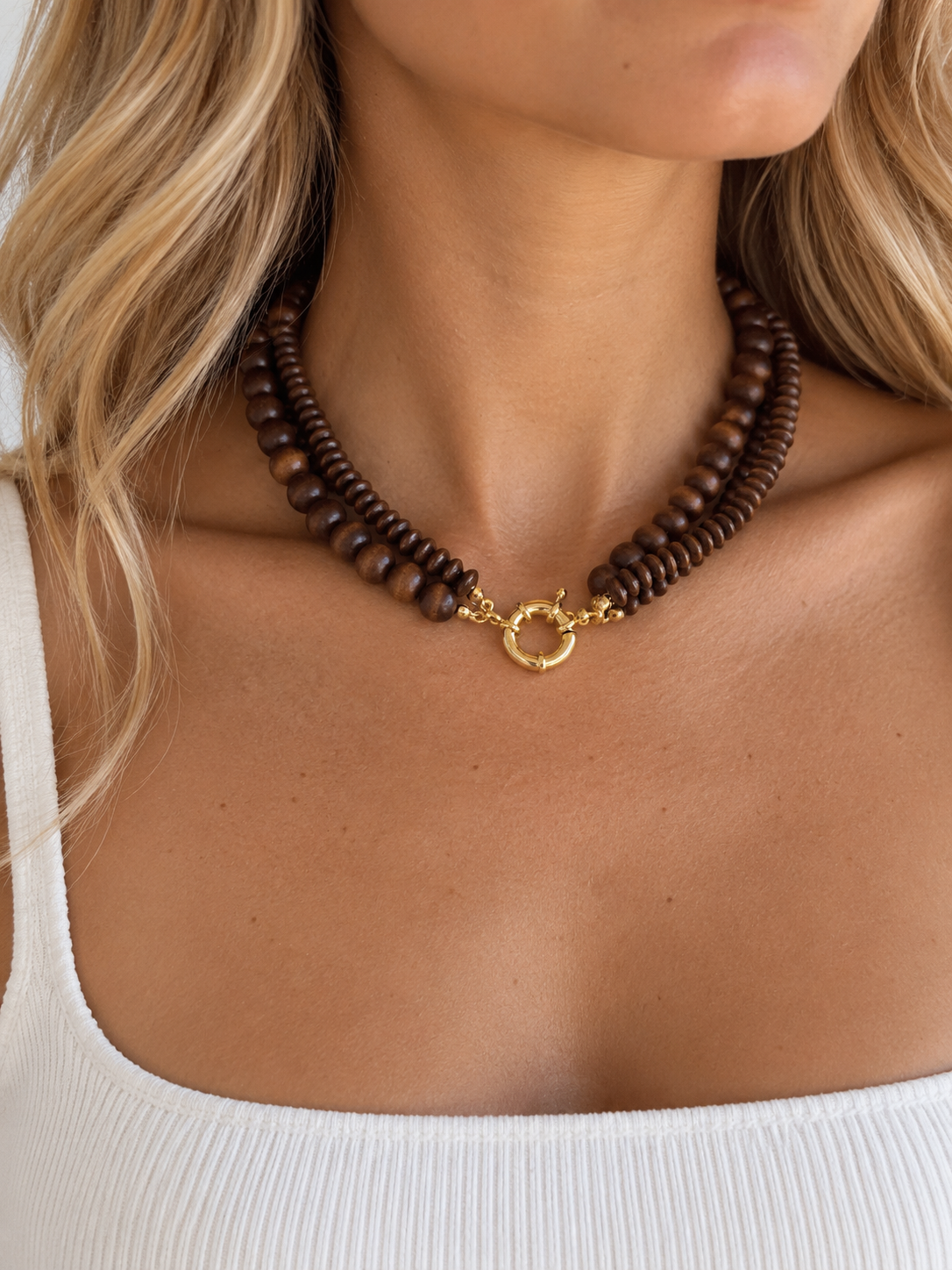
Necklace clasp types affect how you put a piece on, where its detail sits and how easily you can adjust the fit. Start by looking at the fastening as closely as the pendant. A small clasp at the back and a large wheel worn at the front create different experiences, even when the necklaces have similar lengths.
This guide explains the names you are likely to encounter and the questions worth asking before buying. It also compares three OAK + EVE necklaces with documented wheel clasps. The aim is to choose hardware you can use comfortably, rather than assume one shape is best for every wearer.
Separate the clasp from the extender
The clasp closes the necklace. An extender provides additional fastening positions, usually beyond the main strand or chain. A necklace can have a clasp without an extender, and a visible ring is not automatically an adjustment mechanism.
Read the measurement beside the photograph. The Capri Necklace is listed at 16 inches, while the Wooden Beaded Statement Necklace is listed at 15.5 inches plus a 2-inch extender. Those are different specifications. A wheel clasp alone does not tell you how much adjustment either piece offers.
Common necklace clasp names
| Clasp | How to recognise it | What to check |
|---|---|---|
| Lobster | An elongated catch with a small lever | Whether you can operate the lever and reach the receiving ring |
| Spring ring | A circular catch with a spring-operated opening | The opening size and how easily you can hold the ring |
| Toggle | A bar passes through a separate ring | The maker's fit instructions and whether the bar is fully through |
| Wheel | A prominent circular fastening, often used as a design detail | The actual opening mechanism and intended wearing position |
Blue Nile's clasp guide illustrates several common mechanisms. Names are useful for narrowing a search, but a close-up or demonstration is more informative than the label alone. Do not force a clasp because another necklace with a similar name opens differently.
A front-facing clasp can be the focal point
The Wooden Beaded Statement Necklace uses three strands of wooden beads and an 18K gold-filled wheel clasp intended to be worn at the front. Its listed length is 15.5 inches with a 2-inch extender. Here the fastening is part of the composition, rather than a detail to hide behind the neck.
Try a front clasp with a plain top so you can see its scale. Notice whether it sits above the neckline or against fabric. The short starting length deserves a fit check before purchase, especially if you intend to wear it over clothing. The clasp's visual size does not establish the necklace's usable circumference.
Some necklaces offer a front-or-back choice
The Capri Necklace combines freshwater pearls, ceramic floral beads and 3mm 14K gold-filled beads with an 18K gold-filled wheel clasp. Its product description explicitly allows the clasp to face front or back. The necklace measures 16 inches.
That gives you two ways to present the same design. At the front, the metal circle becomes part of the visible pattern. At the back, the pearl and floral details lead. Follow the construction of this particular necklace; a similar-looking clasp on another piece does not establish that it can be worn in both positions.
Check the chain and clasp as separate components
The Eliza Statement Necklace pairs a stainless steel rolo chain with an 18K gold-fill wheel clasp and a freshwater pearl. The chain is listed at 20 inches with a 3-inch cascading chain detail. The cascade is a design feature, not a stated 3-inch extender.
This distinction matters when comparing listings. A gold-coloured clasp does not mean the whole chain has the same composition. Likewise, a drop or cascade measurement describes a different part of the necklace from the strand around the neck. Write down each measurement separately if you are comparing several designs.
Choose for the way you fasten jewellery
Consider where your hands need to be. Some people find a fastening easier to handle in front of a mirror before moving it into place. Others prefer a clasp designed to remain visible. Your own reach, grip and familiarity matter more than a general claim that a particular closure is easy.
If small levers are awkward for you, ask for a clear photograph or demonstration before ordering. Describe what you need to be able to do, such as holding both ends without help. Avoid choosing solely from a styled image where the fastening is hidden behind hair.
Inspect the full connection
Before putting a necklace on, look at the clasp, receiving ring and nearby connections. The clasp should close as intended, with the correct parts joined. If a ring appears open, a catch sticks or a component looks bent, set the necklace aside and ask for advice.
Do not test security by pulling hard on the necklace or hanging extra weight from it. A clasp's appearance does not establish its load capacity, and adding an unlisted charm can change the design. Ask about compatibility before attaching anything to a decorative wheel.
Keep care specific to the complete necklace
The fastening may be metal while the necklace also contains wood, pearls, ceramic or cord. Choose care instructions for the whole piece. A cleaner intended for a plain metal chain may be unsuitable for the other materials connected to it.
Close and store the necklace in its own space after wearing, following its product guidance. For the next buying decision, our necklace layering guide covers combining separate pieces. To compare actual hardware and measurements, browse OAK + EVE necklaces with the fastening in view.
