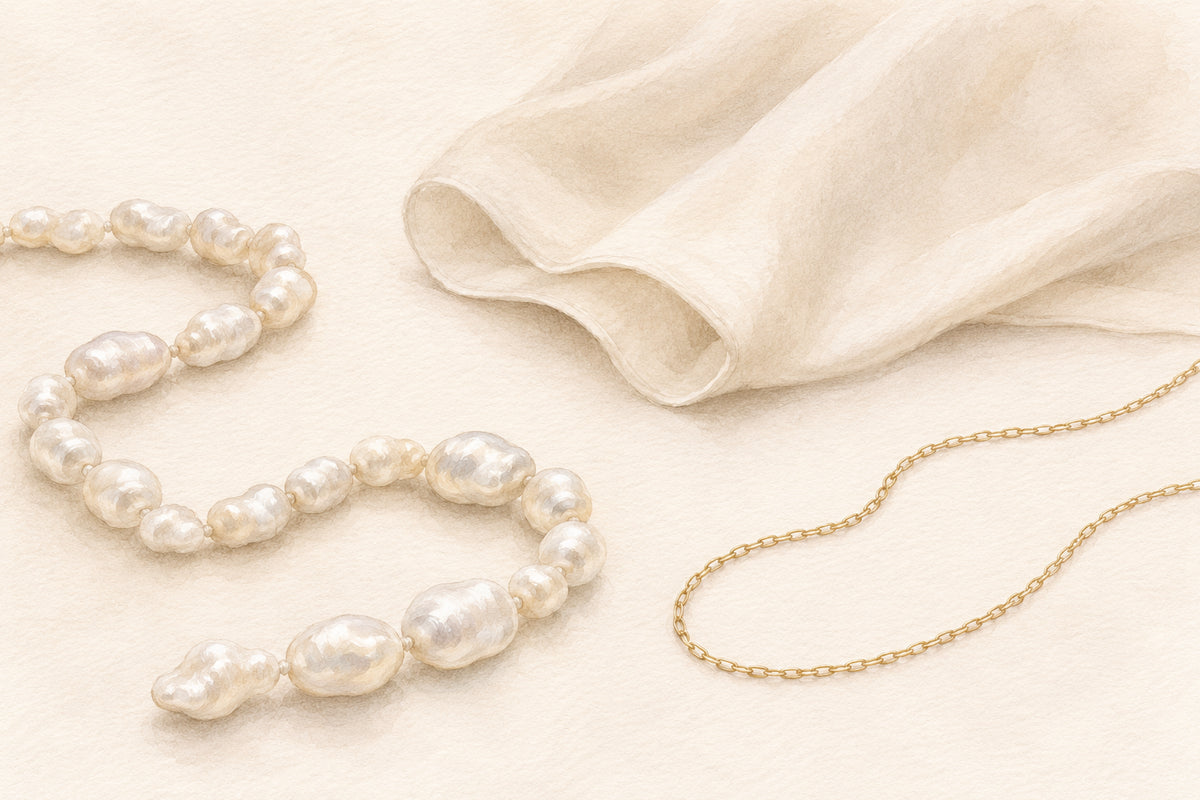
Pearl jewellery does not have to use a row of identical round shapes. Pearls can be rounded, elongated, flattened or irregular, and those outlines change the appearance of a finished design. “Baroque” is one shape description you may encounter, but it should not be used as a substitute for every other pearl term.
Start by separating three questions: what the pearls are, what shape they have and how they are arranged in the jewellery. Freshwater describes their type of origin, while a shape term describes their form. Neither tells you the complete construction of the necklace, bracelet or ring.
What baroque means
The Gemological Institute of America’s shape definitions describe baroque pearls as irregular in form without apparent symmetry. Its shape vocabulary also includes round, near-round, oval, button, drop and semi-baroque. These distinctions help describe what you see rather than putting every non-round pearl into one category.
A product listing may use a broader word such as “irregular” rather than a formal classification. Keep that wording attached to the actual product. Do not upgrade a seller’s description to a more specific shape category without confirmation.
Shape is separate from pearl identity
An irregular outline does not prove a pearl is genuine, and a neat round outline does not prove it is an imitation. Appearance alone cannot answer that question. Use the product’s component information and ask the seller or a qualified gemologist if you need a specific identification.
Our freshwater and imitation pearl guide covers that separate issue. This article focuses on choosing the shape and arrangement you enjoy once you have read what the finished piece contains.
Compare the outline at the right scale
A highly enlarged photograph can make small differences in outline seem more prominent than they appear when worn. Look for stated pearl measurements and photographs that show the full piece. Use both rather than choosing from a close-up alone.
Also consider whether the design uses many small pearls or one focal pearl. The same kind of variation can read as a textured strand in one design and a single visible detail in another. You are choosing the whole arrangement, not grading a loose pearl from an image.
A fine strand of irregular pearls
The Leilani Pearl Necklace is described with tiny irregular freshwater pearls and 18K gold-filled findings. Its length is 16 inches with a 2-inch extender. The listing notes that pearl shapes may differ.

That description supports expecting variation in a delicate strand. It does not establish a formal baroque classification for every pearl. Consider it if you like the appearance shown in the design and are comfortable with the natural differences described by the seller.
Compare where the strand will sit with the neckline you wear. The small pearl scale and the overall necklace length work together. A close-up of the pearls cannot establish how close-fitting the completed necklace will be on you.
A bracelet with a different scale and fastening
The Malia Pearl Bracelet uses 6mm freshwater pearls, an 18K gold-filled nautical wheel clasp and findings, and gold-coloured bead wire. Its larger stated pearl size gives you another scale to compare with a finer pearl strand.
The wheel clasp also changes the finished appearance. Look at the pearls and fastening together rather than choosing only by bead diameter. The product description should guide the material expectations; it does not require you to give the pearls a shape label that the listing does not provide.
Compare arrangement across a collection
The Greek Islands necklaces combine freshwater pearls, hand-beaded Miyuki flowers and 18K gold-filled findings. The Mykonos is 16 inches, the Santorini 18 inches with a 2-inch extender, and the Rhodes 20 inches with a 2-inch extender. The Rhodes listing describes pearls in varying sizes.
Here, shape and size sit within a broader design of flowers, findings and different necklace lengths. Choose the version whose complete arrangement you want to wear. Check the currently available variant rather than assuming every necklace in the product photograph is available at the moment you order.
One pearl can be enough
The Everly Freshwater Pearl Ring combines a freshwater pearl with stretch elastic. Its simple construction places attention on one pearl rather than a repeating strand. Read its own size options rather than assuming stretch removes the need for a correct fit.
A focal pearl can be an option if you enjoy pearl detail but do not want a full necklace or bracelet. The decision is about placement and scale. It does not need a formal shape label to be a useful choice.
Matching and variation are different preferences
You may prefer repeated outlines, or enjoy visible differences between pearls. Consider how much variation you expect to see from the product description and whether the photographs show one sample or the exact piece. Ask if that distinction matters to you.
Do not assume every irregular pearl item will look identical to its photograph. Equally, do not assume a piece is poor quality simply because its design includes variation. A useful comparison asks whether the described variation is part of the appearance you want.
Choose a shape in the context of an outfit
Try to picture where the pearl detail will sit: close to a collar, at the wrist or on a finger. A simple top can make a strand’s texture clearer, while a patterned outfit may put more attention on the overall silhouette than individual pearls.
If you already own pearl jewellery, compare the placement and scale before adding another piece. You might want a different role rather than a different label. A ring, bracelet and necklace can each give you a distinct way to wear pearls without repeating the same outline near the same part of the body.
Read the description before choosing the name
Confirm pearl type, stated size where provided, findings, fastening and any variation note. Keep formal terms such as baroque for products actually described that way. This makes the comparison more accurate and keeps the focus on what you will receive.
To explore current examples, browse necklaces, view bracelets or compare rings. Choose the pearl arrangement you enjoy and the construction that suits you, with the product’s own wording as your reference.