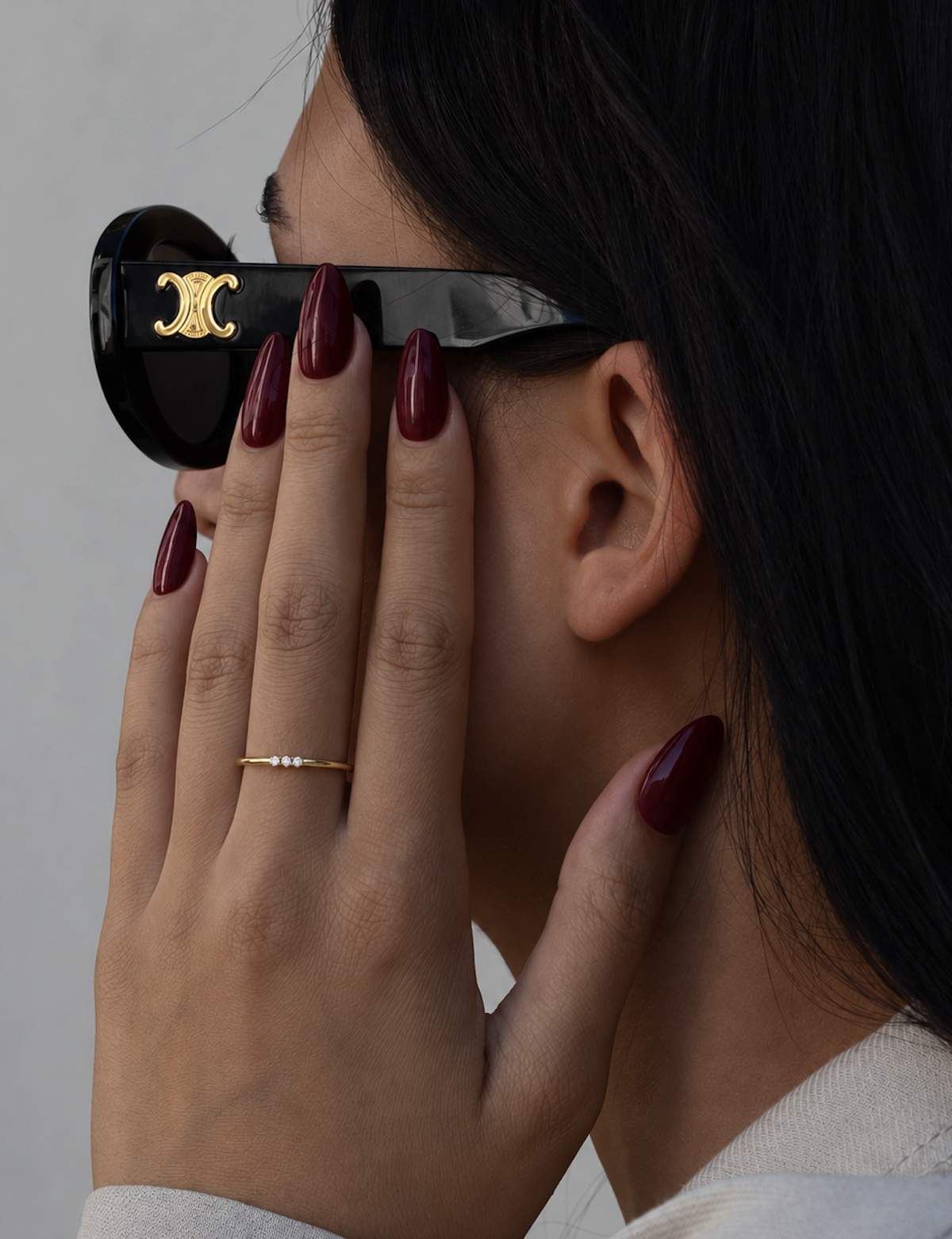
Cubic zirconia, often shortened to CZ, is a manufactured gem material used in jewellery for its sparkle. It is different from diamond, including a laboratory-grown diamond. If a product lists cubic zirconia, that is the material description to use when comparing it, caring for it or giving it as a gift.
The useful next question is how the CZ is incorporated into the piece. A ring with three small stones, a crystal-covered hoop and an ear cuff create different effects. This guide explains the terminology and compares OAK + EVE designs with specific listed components.
CZ is a material in its own right
The Gemological Institute of America's overview of simulants identifies synthetic cubic zirconia as a man-made material. In jewellery terminology, a simulant can resemble another gem while having different chemical, physical and optical properties.
That distinction is about accurate identification. You can choose CZ because you like its appearance and the design that uses it. There is no need to describe it as diamond to make the piece meaningful or wearable.
Cubic zirconia and laboratory-grown diamond are different
| Label | What it tells you | Buying implication |
|---|---|---|
| Cubic zirconia or CZ | A manufactured gem material used for its appearance | Compare it as CZ, with the full jewellery specification |
| Diamond simulant | A material that can resemble diamond but differs from it | Ask which specific material is used |
| Laboratory-grown diamond | Diamond produced by a manufacturing process | It is a separate material category from CZ |
GIA's laboratory-grown diamond questions and answers explains this separation. A seller should describe the material clearly. A photograph of a sparkling stone cannot establish that it is CZ, diamond or another material.
Read the metal description separately
CZ describes the stone, not the metal around it. A piece can combine CZ with gold-filled components, sterling silver, plated materials or another construction. Read the posts, band, chain and findings where these are listed.
A material name also does not establish that a whole design is waterproof, suitable for a metal sensitivity or able to withstand every activity. Those questions depend on the complete piece. Ask for any component information you need rather than drawing a conclusion from the sparkle.
A small ring can make the CZ detail precise
The 14KT Gold Filled Stacking Ring with 3 CZ Crystals is listed with three cubic zirconia crystals and a 14KT gold-filled band. The band width is 1.27mm, and the product lists sizes 5 to 9.
Three stones create a different pattern from a ring covered in stones. Compare the arrangement with the rings you already wear and consider whether you want a small repeated detail or one larger focal point. Check the actual selected size and its availability rather than treating the full listed range as a stock promise.
For stacking, try the ring in the intended position on its own first. Another band should not need to press against the crystal setting to make the combination work. Use the maker's fit and care guidance for each piece.
A hoop distributes sparkle around a curve
The James CZ Hoops list 18K gold filled and cubic zirconia crystals, with measurements of 22mm by 8.5mm. The design places multiple small details around a hoop rather than concentrating them on a fine ring band.
Use a ruler to understand the listed scale, then compare it with earrings you own. The relationship between the hoop and your ear is more informative than the word dainty or statement. Look at front and side photographs so you understand which surfaces are visible when worn.
An ear cuff offers another placement
The Hilary Cuff is an 18K gold-filled ear cuff with baguette CZ crystals. Its dimensions are 16mm by 14.2mm by 5.6mm. A cuff is a different construction from a hoop worn through a piercing.
Follow the cuff's fitting instructions and remove it if it pinches or feels uncomfortable. The stone shape and the cuff shape are separate choices: baguette describes the crystal detail, while the curved cuff determines how it sits on the ear. Neither label guarantees comfort for every person.
Compare sparkle in the setting you will wear it
Try jewellery beside the fabric and neckline of an actual outfit. A small amount of reflected light may be enough for an everyday look, while you may enjoy more visible detail for another occasion. There is no required level of sparkle for a particular age or event.
If a product photograph uses close-up lighting, also look for a wider view that shows the piece's proportions. A macro image is helpful for understanding the setting, but it can make a tiny component appear much larger than it will on the body.
Care for the setting and the rest of the piece
Use the product's care instructions for the assembled jewellery. A cleaning method chosen for a loose stone may be inappropriate for the metal finish, decorative parts or how a stone is held in place. Avoid experimenting with an ultrasonic cleaner or abrasive product without confirmation that it suits the piece.
Check for loose stones, bent parts or a change in the setting before wearing the item again. If something looks different, save a clear photograph and contact the store. Do not press a stone back into place or assume a cloudy appearance identifies a particular material.
Compare current earrings and choose the scale, placement and materials you want. Accurate CZ terminology makes it easier to understand the piece you are buying and to describe it honestly when you give it.
