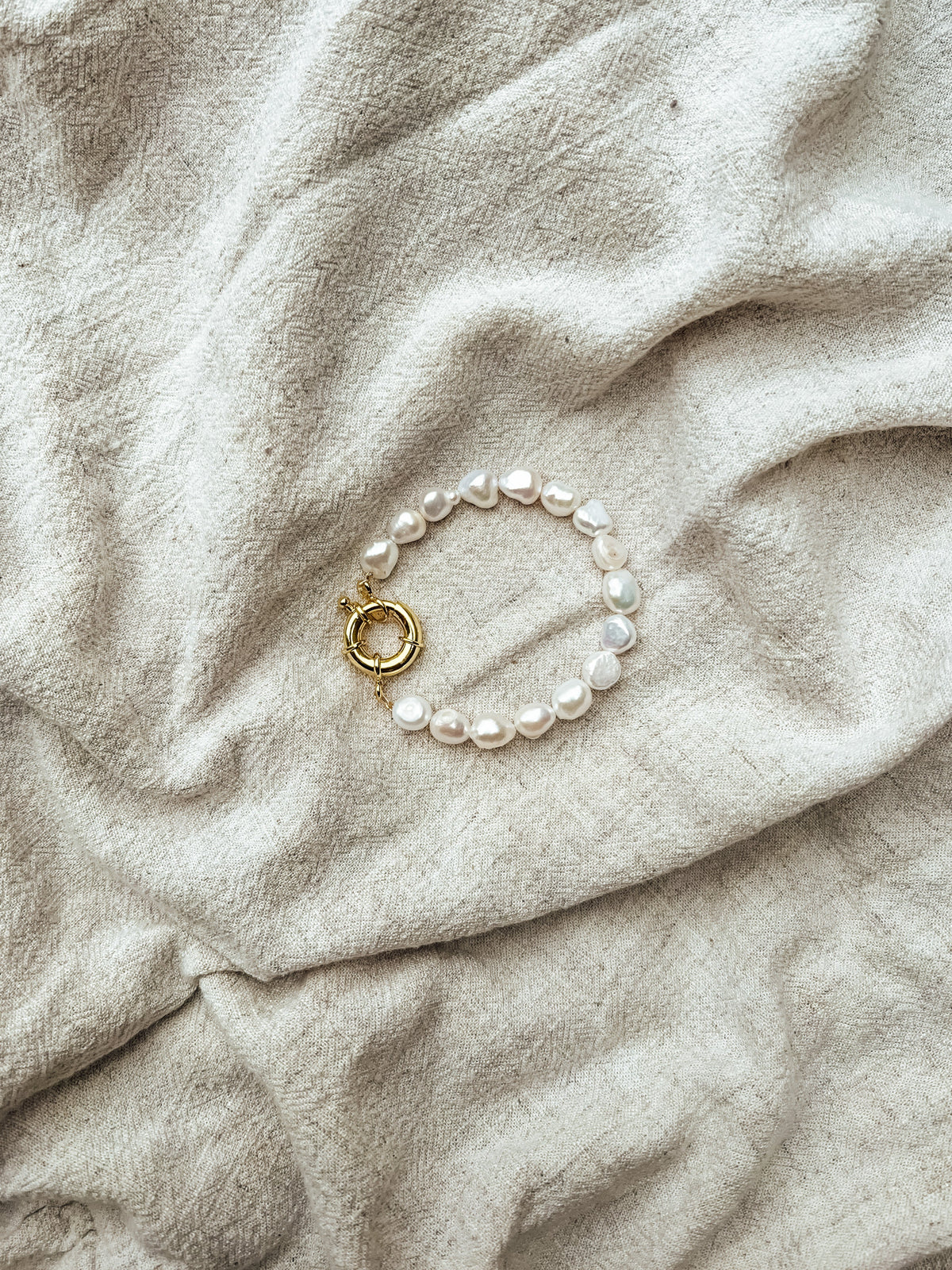
Bracelet clasps deserve attention before you choose a colour or bead pattern. You will be fastening the piece around one wrist, often using the other hand alone. The right closure for you depends on how it opens, the fit it provides and the way you use your hands during the day.
A wheel clasp, a chain with an extender, sliding knots and stretch elastic solve different problems. This guide compares those constructions using OAK + EVE examples and explains what to check when a product page names a fastening without showing how it works.
Three questions to ask about a closure
First, establish how the bracelet goes onto the wrist. Does it open, slide over the hand or loosen through a knot? Second, find out how its wearing length is set. Finally, check what closes the connection or holds the adjustment in place. These are related questions, but they are not interchangeable.
A bracelet may have both a clasp and an adjustment mechanism. Calling it adjustable tells you little about the range or the hand movement needed to use it. Read the complete description and ask for clarification where the fastening is not shown.
Compare the construction before the appearance
| Construction | Buying question | Wearing check |
|---|---|---|
| Wheel clasp | How does the circular catch open? | Can you align and close the correct connection? |
| Clasp with extender | What is the starting length and added range? | Which fastening point feels comfortable? |
| Sliding knots | How are the knots moved on this design? | Does the adjusted bracelet stay comfortable as you move? |
| Stretch elastic | Which offered size suits your measurement? | Can it pass over your hand without being forced? |
Jewelers Mutual's clasp overview describes common catches used across bracelets and necklaces. It is a useful visual reference for names such as lobster and spring ring. The exact product still determines the fastening you receive.
A wheel clasp with pearls
The Malia Pearl Bracelet uses 6mm freshwater pearls and an 18K gold-filled nautical wheel clasp. Its listed components also include gold-coloured bead wire and 18K gold-filled findings. The visible circle forms part of the bracelet's appearance.
Ask how the catch operates if the product image does not show the opening. Do not use the pearls as handles while pulling the two ends together. Bring the fastening components into position carefully and check the connection before moving your hand away. A prominent clasp can be attractive without necessarily being easier for every wearer.
A chain bracelet with a stated extender
The Willow Paperclip Chain Bracelet is listed at 5.5 inches with a 2-inch extender. Its catalogue offers sterling silver and 14K gold-filled versions. The extender provides fastening options within that stated range; it does not establish a universal fit.
Notice where the unused extender falls once the bracelet is fastened. Try the movement of your wrist against the cuffs you normally wear. If the end repeatedly catches, ask about the design before making an alteration. Cutting or bending an extender is not a routine fit adjustment to make at home.
A pearl bracelet with a decorative extender end
The Bianca Bracelet also measures 5.5 inches with a 2-inch extender. Its materials are freshwater pearls, 14K gold-filled beads, an 18K gold-filled extender and gold-filled findings. A pearl finishes the extender.
The same starting length as the Willow does not guarantee the same feel. The pearl construction occupies space differently from open chain links. The decorative end is also something you may see or feel as the bracelet moves. Compare the full design with the way you prefer jewellery to sit.
Sliding knots are an adjustment method
The Run For The Cure Adjustable Rope Bracelet has rope cord, a stainless steel clasp and knots that slide to tighten or loosen it. The listing shows both the clasp and the adjustable construction. Those details should be considered together.
Use the product's instructions to move its knots. A sliding knot is not the same mechanism as a metal slider bead, and instructions for one should not be transferred to the other. Check that the bracelet is adjusted comfortably after putting it on, without assuming the phrase one size means every wrist.
Stretch bracelets have no clasp to operate
Elastic construction can remove the step of joining two ends, but it introduces a separate fit decision. Stretch helps the bracelet pass over the hand. It does not mean you should keep pulling until a small size fits.
Use our bracelet sizing guide to establish a measurement, then use the guide for the exact piece. If the elastic looks strained, the fit changes or the bracelet feels restrictive, stop wearing it and ask for advice.
Practise over a clear surface
Give yourself room to see the fastening before wearing a new bracelet out. A soft, clear surface can make small parts easier to find if you drop them. Keep loose jewellery components away from children and pets.
Inspect the closure without forcing it. If it does not work as expected, contact the store instead of changing the shape of a hook or ring. You can choose a different construction if fastening one type remains awkward; enjoying a bracelet should include being able to put it on and remove it.
Make the choice from a complete specification
Before ordering, note the closure, starting length, adjustment range, materials and offered size. If one detail is missing, ask about that detail rather than guessing from the photograph. For gifts, include the product name so the recipient can find the same instructions.
Compare OAK + EVE bracelets by fastening as well as style. A carefully chosen closure can make the difference between a piece you admire and one you can comfortably use.
