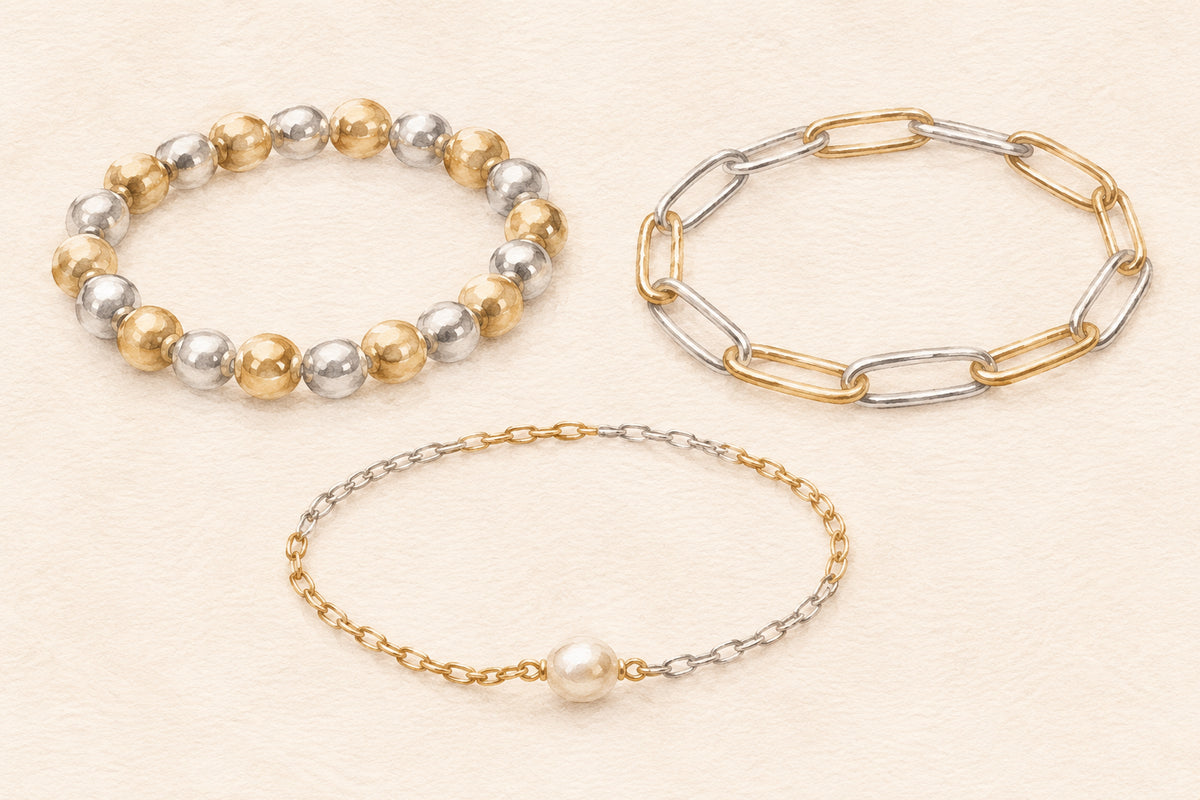
Gold-filled and gold-plated jewellery both give you a gold surface over another metal, but the terms describe different constructions. Neither means that the whole piece is solid gold. To compare two designs properly, look beyond the colour and karat number to the component list, fastening, size and care instructions.
A useful buying decision starts with the piece you want to wear. A gold-filled bead necklace and gold-plated sculptural earrings serve different purposes. Choosing between them is partly a material question and partly a question of shape, budget and the way jewellery fits into your day.
What gold filled means
The Competition Bureau’s Canadian marking guidance describes gold-filled items as a gold layer affixed to a base metal. Its requirements include a minimum gold quality and a minimum proportion of gold by weight. Gold-filled is therefore a construction description, not another name for solid gold.
A listing that says 14K gold-filled beads identifies the beads. It does not automatically describe a cord, elastic, wire, clasp or earring post attached to them. Read the complete description to understand what the finished design contains. If a component is unclear, ask the seller to name it.
What gold plated means
Gold-plated jewellery also has gold applied over another material. The product description should identify the underlying material where it matters to your choice. For example, gold-plated stainless steel is a different description from a piece described only as “gold”.
The Canadian marking guidance distinguishes gold-plated and gold-filled constructions. A colour photograph cannot establish coating thickness, gold proportion or the method used to make a particular piece. Those details need product or supplier information. Avoid turning a general explanation into an assumption about an item you have not checked.
Separate the karat number from the construction
A karat number and the words “filled” or “plated” answer different questions. The number describes the gold alloy associated with the component; the construction term describes how that gold relates to another material. Reading only “14K” or “18K” leaves out a significant part of the description.
When comparing listings, write down the full phrase rather than shortening it to “gold”. Keep any component qualifier with it. A necklace can have one specification for its beads and another for its findings. This is especially useful when you are comparing pieces from different brands or trying to match something already in your jewellery box.
Compare three actual designs
The Letti Necklace uses 3mm 14K gold-filled beads and gold-filled findings. Its stated length is 16 inches with a 2-inch extender. It offers a fine beaded line, so its material and dimensions can be considered together when deciding whether you want a close necklace layer.

The Willow Paperclip Chain Bracelet is listed in 14K gold-filled or sterling silver versions. It measures 5.5 inches with a 2-inch extender. Here you can compare the two offered materials in the same chain design rather than comparing unrelated shapes.
The Priscilla Earrings are listed in gold-plated stainless steel and stainless steel silver versions, measuring 2.4cm by 3.14cm. Their sculptural form gives a different visual result from the Letti’s beads. The gold-plated description should stay attached to the gold version when you compare it with other earrings.
Use price alongside the full product details
Price can help you stay within a budget, but it cannot identify construction on its own. A more complex design, different scale or additional components can affect the price independently of the gold finish. Compare the actual material description and the design you receive.
Check which variant is selected before comparing costs. A silver version, a different size or another component choice may have its own price. Use the current product page and cart to confirm the option you intend to buy. A blog article should not be your only reference for a changing price.
Avoid lifetime comparisons without evidence
It is tempting to ask how many years one finish will last compared with another. A meaningful answer depends on the component, coating specification, construction, frequency of wear and care. A material name alone cannot establish a personal lifetime guarantee.
Instead, ask what information is available for that exact piece. Look for specific care instructions and any written warranty or repair terms. Do not assume a gold-filled or gold-plated label means waterproof, tarnish-proof, suitable for workouts or appropriate for every metal sensitivity.
Think about the parts that touch your skin
An earring’s decorative front and its post may have different materials. The same is true of a bracelet’s beads and clasp. If you know that you react to a particular metal, check the relevant components before ordering rather than relying on the overall colour.
A claim about one material does not identify every alloy or component in a finished design. Ask for clarification where needed. This article compares construction terms; it does not certify an individual piece as suitable for a skin sensitivity.
Choose a care routine you can follow
Read the care instructions for the complete design. Pearls, stones, elastic and other details may change what is appropriate even when two pieces share a gold-filled component. Do not use a cleaner intended for plain metal on a mixed-material piece without checking.
Our gold-filled jewellery cleaning guide addresses that separate care question. Keep the product information with your order details so you can refer back to the correct instructions later, rather than trying to remember which finish you selected.
A practical comparison checklist
Before buying, confirm the full material phrase, which components it describes, the selected variant, dimensions, fastening and care requirements. Then decide whether the shape and wearing experience suit you. If two listings leave different questions unanswered, resolve those questions before treating them as equivalent.
Gold-filled can be the choice you prefer for one design, while a plated piece gives you the shape you want for another. To compare current options, browse necklaces, explore bracelets or view earrings. Choose with the complete description in front of you, rather than asking the colour alone to tell the whole story.